$CNCRT at the National Assembly: What We Presented, and What Policymakers Asked
On July 8, Wavist's full-cycle K-content RWA case was presented at a policy seminar in Korea's National Assembly — a room where the question has shifted from whether K-content can be securitized to how the domestic framework should accommodate it.
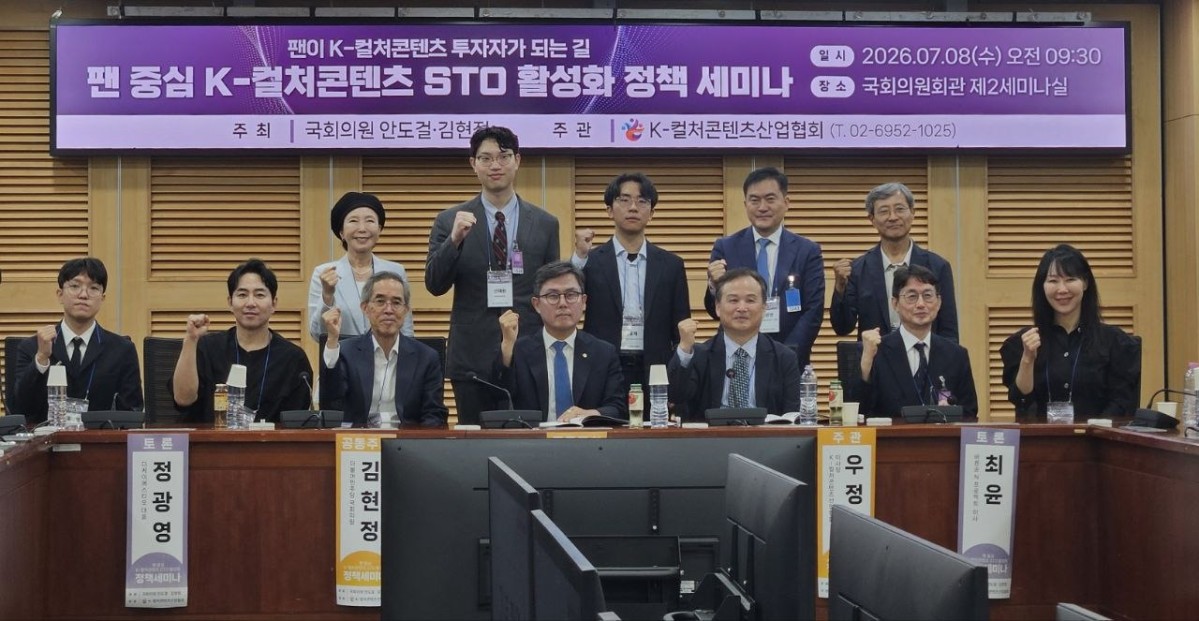
On July 8, 2026, the National Assembly Members' Office Building in Yeouido hosted a policy seminar on fan-centric K-culture content STOs (security token offerings), co-hosted by lawmakers Ahn Do-geol and Kim Hyun-jung of the Democratic Party and organized by the K-Culture Content Industry Association (KCCIA). Brian Hong, Director of Pledge — the operator of Wavist — delivered one of the two main presentations, on the global capitalization of K-content IP, drawing on the $CNCRT program's completed issuance-to-redemption cycle.
That a session like this is being held inside the National Assembly is itself the headline. Korea's amended Electronic Securities Act and Capital Markets Act passed in January 2026, the implementing framework takes effect on February 4, 2027, and the Financial Services Commission is expected to release subordinate regulations and guidelines this month. The policy conversation has moved past whether content-backed token securities should exist. It is now about plumbing: trust structures, custody classification, collateral frameworks, valuation. This post summarizes what we presented and what the room debated.
What we presented: a completed cycle, and its friction points
Our presentation made one central claim: K-content is now a global investment subject — the constraint is product form, not investor appetite.
The evidence was $CNCRT Tranche 1, the $1 million note backed by Korean concert cash flows that we have documented in detail in our case study. Issued in December 2025 and redeemed in full — principal and interest — in May 2026, the note completed its lifecycle with issuance, ownership records, and retirement processed entirely on-chain, without paper certificates or a separate ledger. A cross-border contract with an overseas institutional investor ran start to finish on the schedule and procedures agreed at signing.
"In the course of executing this business, we met overseas investors who consistently expressed the intent to invest in the value of K-content IP. Our judgment is that K-content has become a global investment target. The first problem we ran into was the form — there was no ready product structure to receive that global interest as actual investment."
The presentation was equally explicit about why this happened offshore. At the time of issuance, Korea had no framework or infrastructure to lawfully issue a token security and carry it through settlement and servicing, so the program used Regulation S, the U.S. exemption for offerings conducted outside the United States. Offshore execution was a sequencing decision, not a preference.
We also shared the friction points, because they are where policy work is needed. Some investors wanted to subscribe in dollar stablecoins; no Korean institution was positioned to receive and account for them, so the transaction settled in fiat U.S. dollars. Digital-asset settlement practice has not yet taken root domestically, and the tax treatment of cross-border token security flows remains to be defined. A completed transaction surfaces these gaps more precisely than any position paper.
What the room debated
The seminar's other presentation and the panel discussion mapped the remaining institutional gaps from different angles.
Jung Hyun-kyung, chairperson of Musicow — the company that pioneered fractional investment in music copyright in Korea — focused on music securities. Her core issue was structural: issuing securities backed by music copyright currently forces a double-trust arrangement between copyright trust management under the Copyright Act and financial trust requirements under the Capital Markets Act, and only a small fraction of neighboring rights (the rights of performers and producers, as distinct from songwriters) sit in trust structures at all. The fan capital is there; the legal conduit is not.
The discussion also turned to our own model. One panelist noted that $CNCRT relied on a parent-company guarantee rather than the IP itself as collateral — workable for an issuer inside a content group, but not a template smaller production companies can follow, and therefore an argument for developing IP-collateral and shared-infrastructure frameworks as the domestic regime takes shape. Another raised classification: platforms handling token securities may fall within virtual-asset custody definitions under the Specific Financial Information Act, which would benefit from refinement before the market scales. Regulators at the table pointed to ongoing work on content IP valuation systems and, notably, to the accumulation of completed cases without investor harm as useful reference material for the securities-filing guidelines now being drafted.
We take these points seriously rather than defensively. A first transaction is supposed to be conservative — group-level credit support was the appropriate way to protect investors in a proof-of-execution deal. How the model generalizes beyond a content group's perimeter is exactly the right question for the institutionalization phase, and it is one the platform architecture we described in our platform overview is designed to grow into.
Why this matters for the K-content RWA category
Three signals from the session are worth recording.
First, the sequencing argument held. The reason to execute offshore first — build a verifiable track record while the domestic framework matures — was treated in the room as a data point for rulemaking, not as regulatory arbitrage. Completed, investor-harm-free cases are becoming inputs to the guidelines themselves.
Second, the convergence timeline is now concrete. With subordinate regulations expected this month and the framework effective February 2027, the window in which offshore execution is the only option is closing on schedule. That is the outcome we have been positioned for: the originator-platform-distributor division of roles we already operate offshore is the same architecture the domestic regime anticipates.
Third, the category is being defined in policy language, not just market language. When a National Assembly seminar spends a morning on trust stacking, custody classification, and IP valuation for content-backed securities, the asset class has entered the institutional agenda. Being in the room — as the case study rather than a commentator — is where we intend to stay.
Looking ahead
The FSC's forthcoming guidelines will set the terms for the next phase, and we expect the questions raised on July 8 — collateral frameworks beyond corporate guarantees, custody classification, settlement in digital assets — to shape the second wave of K-content RWA structures. We will continue contributing what we believe is most useful to that process: completed transactions, documented precisely, with their friction points stated as plainly as their results.
Disclaimer: This material is provided for informational purposes only. It does not constitute an offer to sell or a solicitation of an offer to buy any security in any jurisdiction, including the Republic of Korea, nor investment, legal, or tax advice. Summaries of third-party remarks are based on public proceedings and press coverage and reflect our understanding; the views of other participants are their own. References to completed transactions describe historical facts; past performance does not guarantee future results. Securities referenced were offered and sold outside the United States in reliance on Regulation S and have not been registered under the U.S. Securities Act of 1933 or the laws of any other jurisdiction.